There are three parts of the lens to look at:
Problems with the optics change what the AF sensor measures. Problems with the mechanics change where the lens actually ends up. Both affect how sharp your picture is.
The optics
A camera lens usually has more than ten elements of different glasses, quartz and fluorite, arranged in groups that cleverly make up for each other’s shortcomings. Here’s a simplified lens with the casing and mechanics removed, straight out of the factory and working as it should:
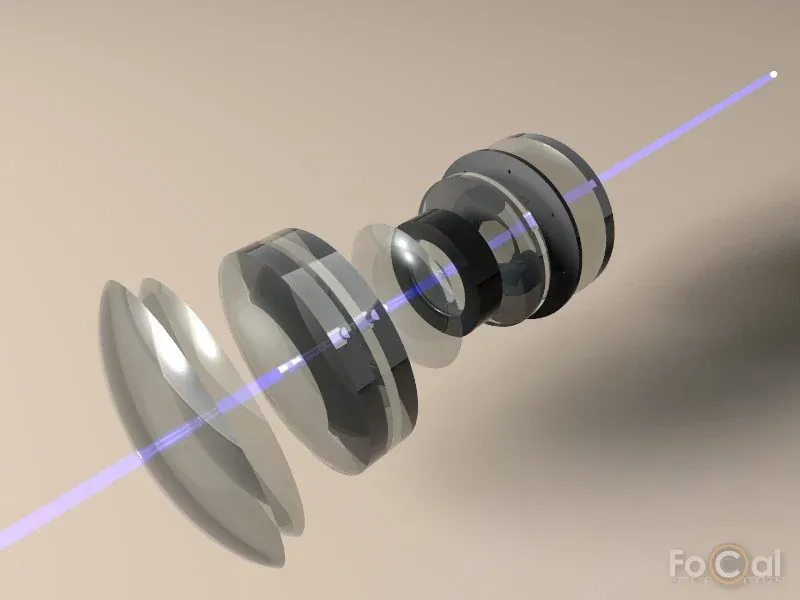
During manufacture, some groups are adjusted with spacers, wedges or screws to bring the lens within tight tolerances. But that was in the factory, perhaps years ago. With so many parts controlling the light, it’s easy to imagine some aren’t quite where they were. Here are some of the ways a lens can lose its edge.
The lens mount
Interchangeable lenses are one of the great things about DSLRs and mirrorless cameras. They also add a joint where the light path can be upset.
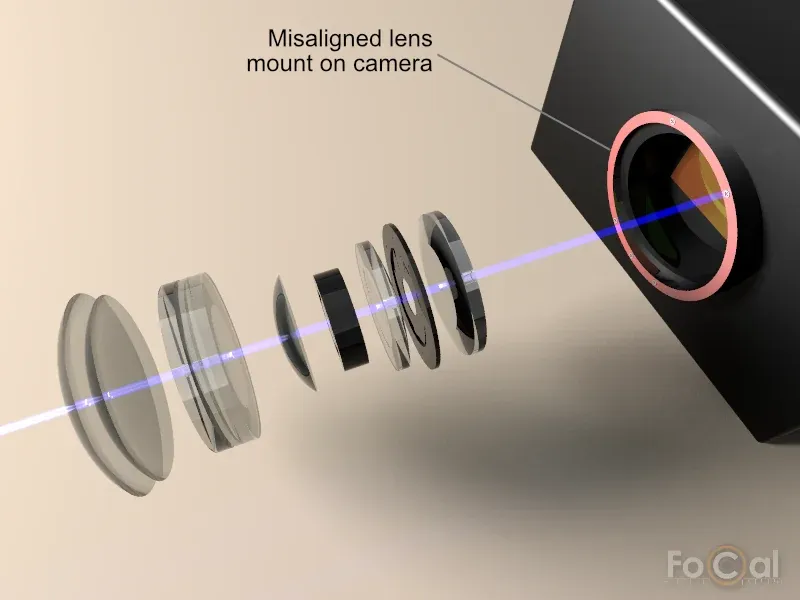
A loose mount screw, a mount that’s shifted under heavy lenses, or a bit of grit on the flange can all tilt the lens slightly. A tilt you’d never see at the mount gets bigger along the lens: 1 degree at the mount is almost 4mm at the front of a Nikon 70-200mm f/2.8. The picture is then sharp on only part of the sensor, and, as we’ll see, the AF pixels notice too.
Mount adapters
Using F-mount lenses on a Nikon Z camera means the FTZ adapter. You can guess what’s coming:
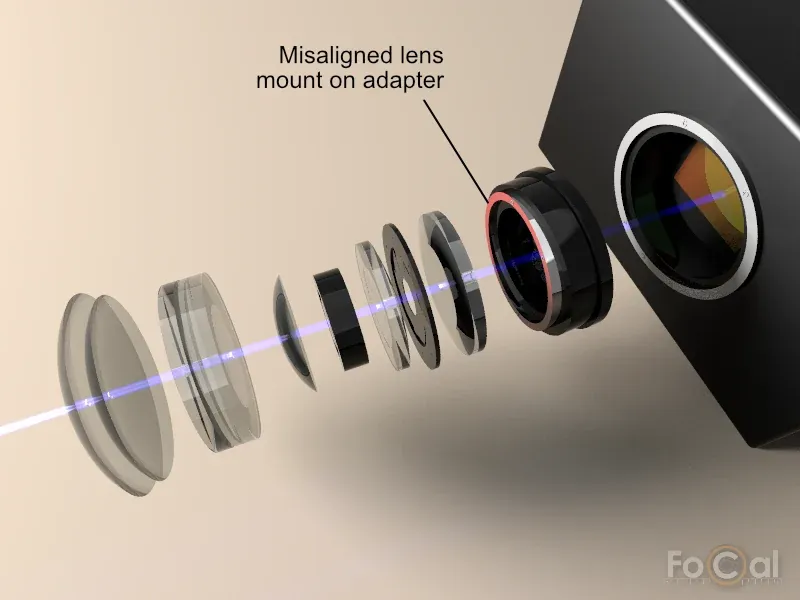
An adapter has two joints, camera-to-adapter and adapter-to-lens, and each can go wrong just like a lens mount on its own. Twice the chance of a tilted light path.
Decentred elements
An element or group is decentred if it’s moved sideways from where it should be (shown in red):
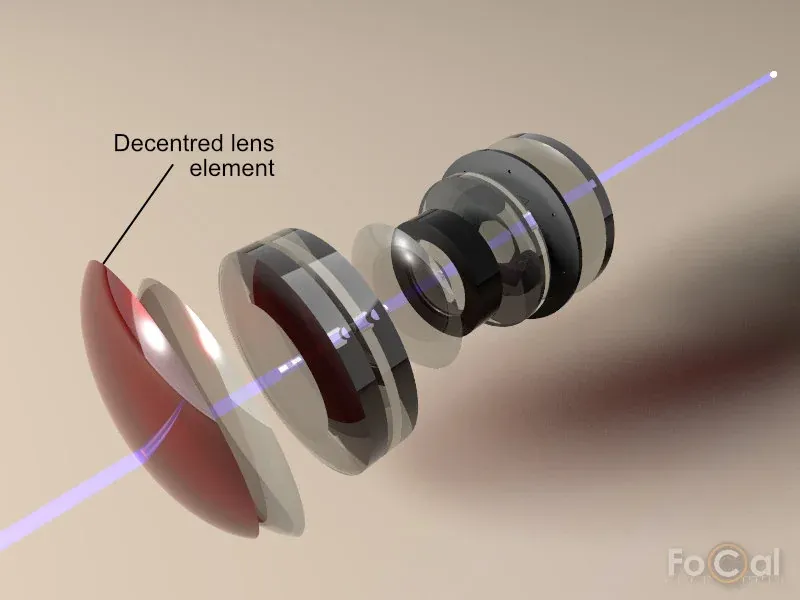
The effect depends on the lens design and which element has moved, from slightly soft corners to a soft picture all over. It also changes the light reaching the AF pixels, so the camera gets slightly wrong information about focus.
Tilted elements
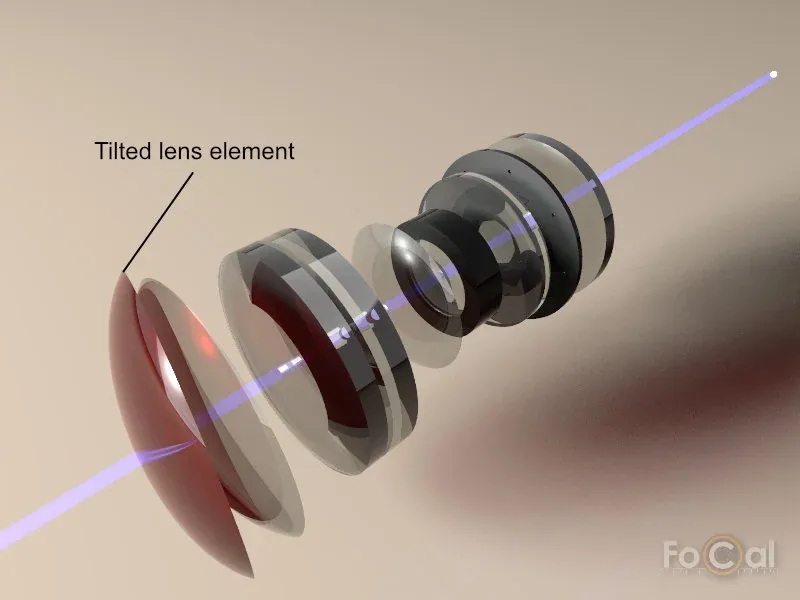
Similar to decentring, and often lumped in with it in testing. In FoCal Pro, the Astigmatism Factor can hint at a tilted element, because it makes pictures sharper in one direction than the other.
Elements in the wrong place
The design expects each element at an exact point along the light path. If one is too far forward or back, the picture may be out of focus, or the lens may not reach infinity.
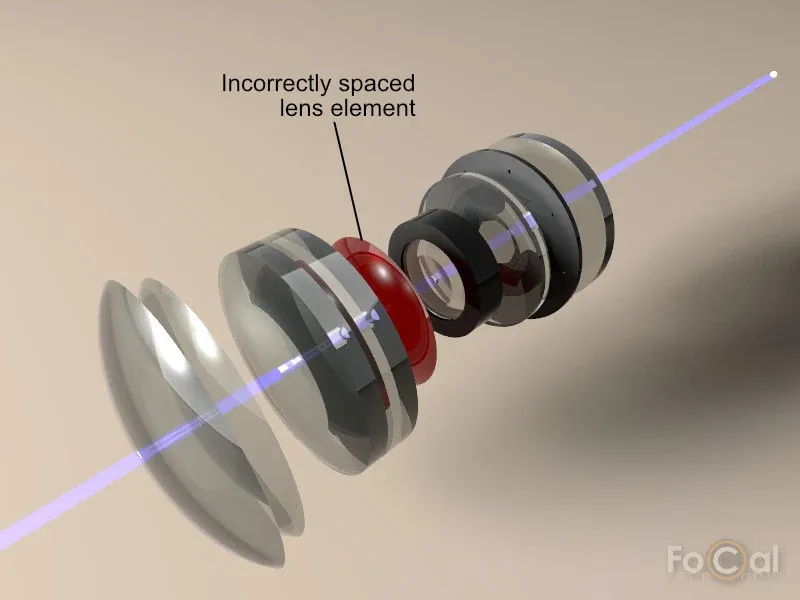
This doesn’t soften one area more than another. It changes how the lens focuses as a whole, which matters when the camera uses the lens’s own correction data (below; not to be confused with AF Fine-Tune).
The image stabiliser
Optical stabilisation uses a floating element moved by an electromagnetic actuator.
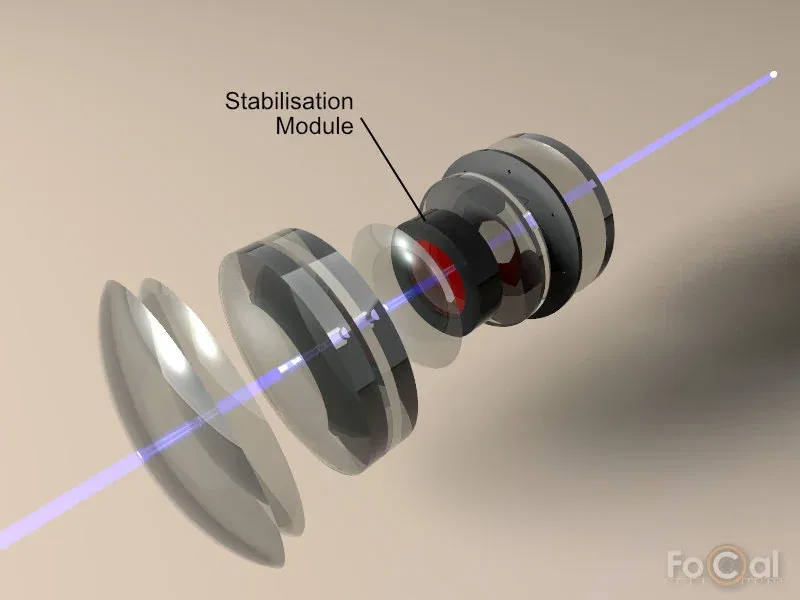
Working properly, its effect on the light path is tiny compared with what it fixes. But if something’s wrong with it, it can cause any of the three problems above: decentring, tilting or wrong placement.
The mechanics
To focus, a group of elements (the focus group) moves back and forth along the lens. On a manual lens your hand does it; on an autofocus lens, a motor.
Four kinds of motor
- In the camera body: a motor in the camera drives the lens through a screwdriver coupling. Found on older lenses with no motor of their own. The least accurate and precise.
- DC motor in the lens: simple brushed motors with coarse speed control and no idea of their exact position, so the lens needs a position sensor. Good enough for film; a long way from what today’s high-megapixel sensors need.
- Ultrasonic motor: first in a camera lens in 1987, with Canon’s EF 300mm f/2.8L USM. Quiet, fast and able to move the focus group in small, precise steps. Common in mid and high-end lenses.
- Stepper motor: quiet, with excellent, precise control. Used in many modern lenses, including all native Nikon Z lenses.
Motor problems
Two things limit how well the motor can place the focus group: its design, and wear.
Screwdriver and DC motors simply aren’t very precise. However good the autofocus, getting exact focus takes several attempts, and then it’s more luck than judgement, like rolling a die until you get a six. Ultrasonic and stepper motors move in well-defined, precise steps.
Older and cheaper lenses tend to have less precise focus control.
And over time, every kind of motor gets harder to control exactly. DC motor brushes wear, changing speed and torque. Particles from use get into an ultrasonic motor’s piezo drive. Bearings wear in all of them. The motor still works, but it doesn’t behave quite as it did in the factory, which matters for the lens’s correction data.
Wear affects the control of every kind of lens motor.
The rest of the mechanics
The motor drives the focus group through gears, rails and other parts, so it’s best to think of the whole lot as one focus control system. Every focus (and zoom) rubs those parts together, and together with motor wear, that slowly changes how the lens responds to the camera.
The control electronics
The lens electronics do much more than switch the motor on. They have fast and slow modes, so the lens can move quickly and roughly or slowly and accurately, with careful braking to stop in the right place. They compensate for backlash, the tiny gaps in the gearing. All of this is tuned for a lens in factory condition, so worn parts make the focus group harder to control precisely.
Worn mechanics can make the lens control electronics less accurate.
AF correction data
When the AF processor has decided where focus should be, it has to tell the lens how far to move. The AF sensor has measured how far out of focus the subject is and which way (see how phase detect works). But turning that into a motor movement depends on the lens: not just the design, but your lens, with all its quirks.
The lens has its own processor, which talks to the camera through the mount contacts and controls the motor. It also holds a table that turns what we know (the current focus position, the one we want, the zoom setting and the aperture) into how far to drive the motor. The camera asks the lens for that figure, then tells the lens to move.
The last step in making a lens is to calibrate it (not to be confused with AF Fine-Tune or AF Microadjustment). Its behaviour is measured, and data describing how this real lens differs from the perfect design is stored in it. That’s the table above. And again, it describes the brand new lens, so wear makes it less accurate.
When the lens’s behaviour changes, its own factory calibration data stops being accurate.
What this does to autofocus
The problems above fall into two groups: ones that tilt the light path relative to the sensor, and ones that change where the lens focuses.
A tilted light path
A camera assumes the lens points exactly square to the sensor. These can tilt it, a little, in any direction:
Think of focusing on a brick wall at an angle to the camera: it can’t all be in focus. The movements here are tiny, but so are the pixels, a few millionths of a metre across. So here’s what the masked pixel pairs see:
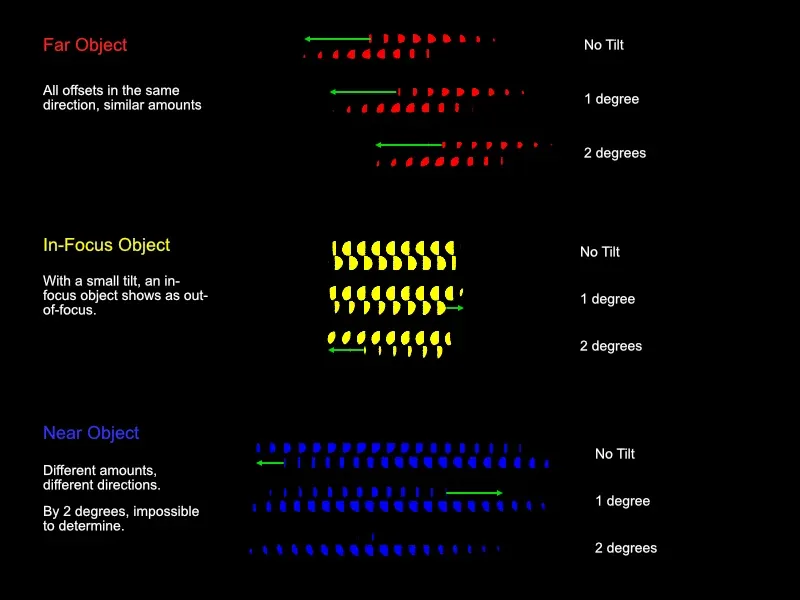
Each target has three pairs: no tilt, 1 degree and an extreme 2 degrees. Look at the yellow, in-focus target. With no tilt, the two images line up perfectly. With any tilt they don’t quite match any more, and the best guesses (the green arrows) report the in-focus target as out of focus, by different amounts and in different directions.
Roger Cicala of LensRentals found the same in testing decentred lenses:
“The most important part is that a decentered lens not only doesn’t resolve as well as a good lens, it focuses less accurately. … If the lens has some spherical aberration, decreased contrast, or (especially for phase detection) difference in side-to-side light paths, focus accuracy could well be affected.”
Changes in where the lens focuses
A new lens is controlled precisely by the camera, thanks to its factory calibration. Over time, these change how it actually responds:
- elements out of place along the light path,
- motor wear, changing how far it moves,
- gear wear, changing the backlash,
- wear in the focus mechanics.
So when the AF processor tells the lens to go to a position, it ends up not quite there.
Won’t the camera just check and correct it? Sometimes, at the cost of slower focusing and perhaps a less accurate result. But there are common situations where the lens is told where to go and the result isn’t checked, and then these errors leave a fixed offset in the focus. That’s the AF processor, next.